A long-standing tradition of exchange student trips within Rotary International District 2240 continues for the sixth time—this time under the official coordination of RYE Slovakia. Organized by Rotary Club Nitra with the support of volunteers from Rotary Club Dunajská Streda and Rotary Club Nové Zámky, the three-day journey to Budapest offered students an unforgettable mix of culture, history, and shared experiences.
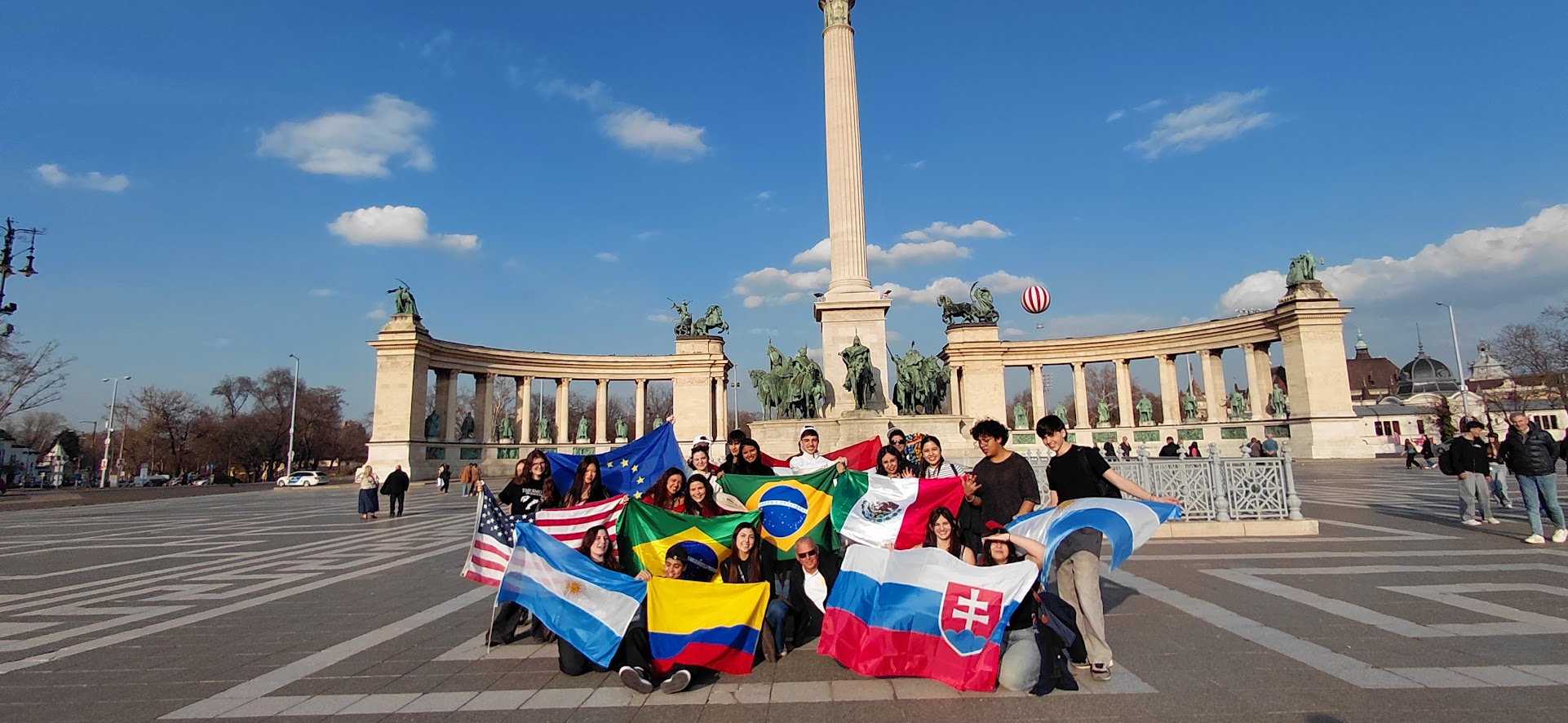
The trip brought together twenty students from Argentina, Brazil, France, Colombia, Mexico, and the USA, giving them a unique opportunity to experience the Hungarian capital not only as tourists, but as young people open to new perspectives and friendships.
From the very first day, after settling in, the group set out to explore the city. Guided tours introduced them to the story of Budapest, formed in 1873 by the unification of Buda, Pest, and Óbuda—an insight that helped them better understand the city’s unique character.
In Városliget, the students were impressed by the modern Museum of Ethnography Budapest, whose roof doubles as a public park. Nearby, the futuristic House of Music Hungary captivated them with its interactive approach to musical history. The contrast between past and present continued with the romantic Vajdahunyad Castle, which—despite its medieval appearance—dates back only to the late 19th century.
Moments of relaxation followed at the famous Széchenyi Thermal Bath, supplied by the extensive network of thermal springs beneath the city. The group then visited Heroes’ Square, where stories of the seven Hungarian tribes and Archangel Gabriel brought early Hungarian history to life.
A highlight was the ride on Budapest Metro Line M1—the oldest metro line in continental Europe, still preserving its original 19th-century charm.
In the city center, the students stopped at the iconic Gerbeaud Café. At Liberty Square Budapest, they reflected on how history—from World War II to the fall of communism—intertwines in one place.
A powerful moment came at Kossuth Square, in front of the impressive Hungarian Parliament Building. Stories about its architect Imre Steindl, who never saw the building completed, and the symbolic “magic number 96” gave deeper meaning to the visit. The building houses the Holy Crown of St. Stephen, contains nearly 700 rooms, and stretches across kilometers of corridors.
Just nearby, the memorial Shoes on the Danube Bank left a lasting emotional impression. The simple metal shoes commemorate victims of World War II and deeply moved many students.
The evening concluded with a cruise on the Danube River. Illuminated bridges, the Parliament, and the castle hill created a breathtaking panorama—making it clear why Budapest is often called the “Paris of the East.”
On the second day, inbound students from Japan, Mexico, and the USA joined the group, enriching the experience even further. The morning highlight was St. Stephen’s Basilica, which—like the Parliament—reaches a symbolic height of 96 meters. Students also climbed the tower for panoramic views.
In the Jewish Quarter, they visited the Dohány Street Synagogue, the largest synagogue in Europe, followed by a relaxed lunch in the vibrant Karaván Street Food Court.
Their walk continued along Váci Street and the historic Great Market Hall Budapest. Crossing the Liberty Bridge Budapest, they reached the Buda Castle district.
The historic Buda Castle offered both a glimpse into history and spectacular views over the city. At Trinity Square Budapest, they admired Matthias Church and the statue of King Stephen I. Nearby, the fairy-tale-like Fisherman’s Bastion enchanted everyone with its architecture and panorama.
Although a spring storm briefly interrupted the program, the evening continued with a meeting with local Rotarians. A cultural performance by the students created memorable moments—especially the song “Voilà,” originally performed by Barbara Pravi, which received enthusiastic applause. The President of Rotary Club Budapest Duna expressed appreciation for the initiative and opened the door to future cooperation.
The evening ended in a relaxed atmosphere at Gozsdu Udvar, where karaoke once again proved that music is a universal language.
The final day was dedicated to relaxation on Margaret Island. Some students enjoyed the thermal baths, while others took peaceful walks in the spring nature. After intense days full of experiences, it was the perfect moment to slow down and reflect.
In the evening, the group returned to Slovakia—students back to their host families and clubs.
This trip to Budapest was not just about sightseeing. Above all, it was about people. The students demonstrated openness, curiosity, and the ability to build friendships across cultures. They returned enriched not only with knowledge, but with memories that will stay with them for years to come.
Budapest revealed its beauty, history, and modern spirit—and once again confirmed that the world feels smaller when people connect and understand each other.
Acknowledgement from the organizers
We would like to thank all participating clubs for their trust in allowing students to travel with us. Our sincere thanks go to RYE Slovakia for including this trip in the official program and for supporting the long-standing tradition of Rotary Club Nitra to visit neighboring countries with inbound students and connect with local Rotary clubs.
Organized by:
Rotary Club Nitra, Rotary Club Dunajská Streda, Rotary Club Nové Zámky
???? Photo & video gallery: https://photos.app.goo.gl/yaEawpH5mB68U9PLA